Paper money was changed to its current size in 1928. Collectors call modern money “small size” notes. Most of these bills are common. However, there are some very rare exceptions. Most rare notes are a special designation known as star notes. Star notes have a star symbol at the beginning or end of the serial number. If money was misprinted while at the Bureau of Engraving and Printing (BEP), and the error was caught by BEP employees, then the misprinted money was replaced with star notes. The star notes are printed ahead of time and they are put into circulation to replace the misprints. Our guide shows you some of the rarer star notes that you are likely to encounter.
- Two Dollar Bill Serial Number Lookup By Name
- Serial Numbers On Dollar Bills
- Canadian 2 Dollar Bill Serial Number Lookup
Red Seal Legal Tenders
These notes were printed for the $1, $2, $5, and $100 denomination. The hands down rarest red seal star note is the series of 1928B $2 legal tender. Another rare and popular note is the 1928 $1 legal tender. 1966 $100 red seal stars were also printed for the star variety. They aren’t necessarily rare, but they are popular. Red seals are a popular type of paper money because they seem very foreign and exotic to the casual observer.
There are also lots of common red seal star notes. Two and five dollar red seals from 1953 and 1963 are extremely common even as a star variety. Any red seal paper money star from 1928 should be inspected closely. There are rare types from that year that we have not listed. Send us pictures of anything from 1928 in order to get a free appraisal.
SERIAL NUMBER and GROUP LISTS for 18- and 32-subject printings through Series 2009 version 2.2.16 2 February 2020.
Blue Seal Silver Certificates
99% of silver certificate star notes are common. We have the few exceptions listed below. Any $1 note from 1928C, 1928D, or 1928E is very rare as a star note (and as a non-star for that matter). The ultra-rarity from the series is the 1933 $10 silver certificate star note. The 1934B $10 star looks similar and it is also a rarity; but it does not even compare to 1933 in terms of value. 1953B $5 silver certificate stars are very rare, and those are actually still frequently available.
There are no star notes from 1935 or 1957 that are going to be rare. Most $1 silver certificates from those year are worth about $5 as the star variety. However, anything from 1928 or 1934 should at least be examined by an expert. There are some varieties within each series that can make something otherwise common be very rare. Condition is still very important when dealing with any star notes.
- 1 day ago Two dollar bills are still printed today, but don’t tell that to the millions of Americans who think that two dollar bills are rare. 2 days ago 2 dollar bill serial number search toronto just found a 1954 2 bill 2 canadian bank note valued at 15 000 2 digits radar special serial number canada don t think 2 bills are real Value Of 1954.
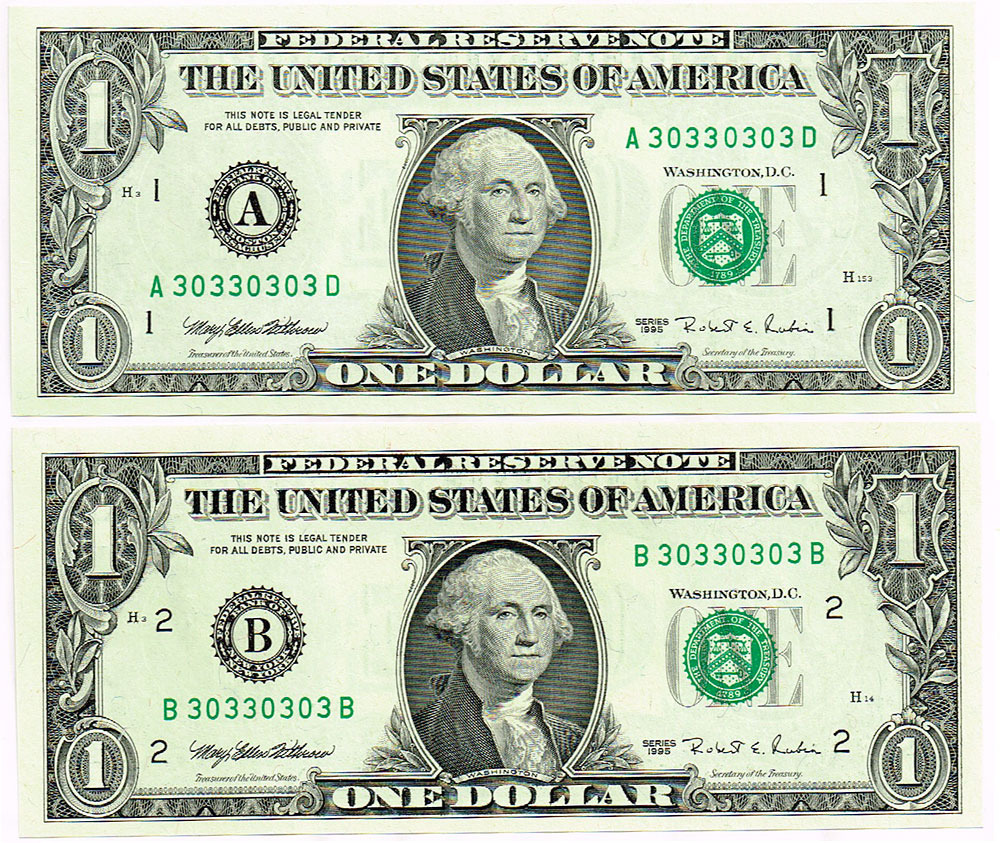
- Each note of the same denomination has its own serial number. Up through Series 1995, all Federal Reserve notes had serial numbers consisting of one letter, eight digits, and one letter, such as A12345678B; now only the $1 and $2 notes still use this form.
- Enter your star note's denomination, series, and serial number to see its production numbers. Series 1981A to present only. Find out why here. $1 $2 $5 $10 $20 $50 $100. 2017A 2017 2013 2009 2006 2003A 2003 2001 1999 1995 1993 1988A 1988 1985 1981A. Something like A01234567. or AB01234567. Lookup Your Star Notes.
Green Seal Federal Reserve Notes
The United States only prints Federal Reserve notes today. The small size types were first printed in 1928. Some notes from 1928 can be very rare (especially $500 and $1,000 star notes). In fact, no matter what the denomination or condition is, we would strongly encourage you to send us pictures of any 1928 star notes. High grade specimens or low serial numbers (under 100) could be worth over $1,000.
We pictured star notes from 1934 above. There are five different series to 1934: 1934, 1934A, 1934B, 1934C, and 1934D. Most star notes from this series are fairly common; although there are exceptions. Some of the star print runs were very small, which makes some of them very rare.

Gold Certificate Star Notes
There were four types of gold certificate stars printed in 1928. Those are $10, $20, $50 and $100 stars. The two lower denominations are relatively common. However, $50 and $100 gold stars are rare. Any denomination in a grade above AU is a good find. Once again, any serial numbers below 100 will also trade for a nice premium. We are especially interested in these notes. Please say hello if you have one.
1929 Brown Seal Federal Reserve Bank Notes

A special type of money was printed in 1929. The notes have a brown seal and they were issued for the twelve different Federal Reserve banks. This series was only printed in 1929. Non-star notes are actually very common. In fact most star notes from 1929 can be bought for less than $600. We do have a few rarer examples listed below.
The ultimate rarity from this series is the 1929 $5 star from The Federal Reserve Bank of San Francisco. A $5 star from The Federal Reserve Bank of St. Louis is also a great find. Any star note issued by The Federal Reserve Bank of Dallas will also be valuable. There are other rare examples scattered into the group. If you have a 1929 star then we would encourage you to send us a picture of it so we can give you a free appraisal.
Hawaii & North Africa Emergency Issues
Some of the most popular small size star notes were printed during WWII to be used by troops in Hawaii and North Africa. The Hawaii issues have brown seals and the North Africa issues have yellow seals (and blue overprints). The standout rarity from the group is the series of 1934 $10 North Africa star. Don’t confuse it with the much more common series of 1934A star.
We also pictured a $20 Hawaii star. Twenty dollar and five dollar stars from Hawaii have the chance to be rare. Contact us for details. Other stars from the series can absolutely be valuable. They just have to be high grade. We would love to see pictures of any star notes you have.
Contact Us If You Have A Star Note You Would Like To Sell:
Info@RareCurrency.com
Two Dollar Bill Serial Number Lookup By Name
When most people talk about silver certificates they probably think back to $1 1957 silver certificates. However, the United States started issuing silver certificates as early as 1878. Silver certificate has kind of taken on a term to describe any old U.S. bill. Of course only some notes actually are silver certificates. Click on your denomination below to learn more about that note.

$1 – $2 – $5 – $10 – $20 – $50 – $100 – $500 – $1000
Large size silver certificates were first printed in 1878. Any note from 1878 or 1880 should considered to be scarce. The next line of silver certificates were issued in 1886. These are available, but you still don’t see them especially frequently.
1891, 1896, and 1899 silver certificates were printed in large numbers. For the most part, 1891 notes look similar to earlier issues. However, the 1896 and 1899 types are distinctive. The 1896 series is famously known as the educational series. The 1899 line of silver certificates present opportunities to own a black eagle, mini-porthole, or a chief.
Serial Numbers On Dollar Bills
Oddly enough, the 20th century saw the issuance of large size silver certificates in just two years, 1908 and 1923. The 1908 example is a fairly tough $10 note. One and five dollar bills were printed for 1923. The $1 bill is exceptionally common and worth around $15 on average. The $5 bill from 1923 is fairly tough, and usually worth at least a few hundred dollars.
Canadian 2 Dollar Bill Serial Number Lookup
I would be happy to help answer any questions you might have about your silver certificate. I am also interested in buying different, rare, or high grade notes of any denomination and type. Sales@AntiqueMoney.com